Radiology has long prided itself on its interpretive precision, the ability to read subtle gradients of gray and translate them into life-altering diagnoses. Yet for decades, the final output of that precision was handed off in formats that were inconsistent, unstructured, and often impossible to compare. The evidence that structured reporting addresses these problems is now overwhelming. The question is no longer whether to adopt structured reporting. It is how to do it without disrupting the workflows that radiologists already depend on.

Structured Reporting in Radiology: The Case Is Closed
Structured reporting in radiology is no longer optional. It is the standard of care endorsed by every major imaging society. This article examines the evidence, addresses the legitimate objections, and shows what successful implementation looks like with KailoFlow.
What the Leading Imaging Societies are Saying, and Why it Matters
The position of the world’s major radiology societies on structured reporting has never been more aligned. The Canadian Association of Radiologists (CAR) established a dedicated Structured Reporting Working Group that produced a formal national position statement, concluding that structured reporting enhances clarity and improves communication of radiological findings, and explicitly supporting the development and implementation of policies and reporting tools that increase the use of structured reporting for medical imaging. The American College of Radiology (ACR) has built an entire ecosystem around this principle. Its Reporting and Data Systems (RADS) lexicons, including BI-RADS, TI-RADS, LI-RADS, and PI-RADS, are arguably the most widely adopted standardized frameworks in modern clinical medicine. The European Society of Radiology has similarly issued position papers calling for universal adoption.
This convergence is not coincidental. It reflects a body of peer-reviewed evidence accumulating steadily for the better part of two decades. Research published in Academic Radiology demonstrated that structured reports are both more complete and more effective than their unstructured counterparts. Studies on prostate MRI structured reporting showed measurable improvements in interdisciplinary communication. Thyroid ultrasound template reporting has been shown to reduce errors and improve efficiency simultaneously. The checklist function inherent in structured templates has even been shown to reduce missed findings in cervical spine CT, an outcome with direct patient safety implications.
“Structured reporting helps to establish a minimum standard for the type of information that must be included in a report to make it complete and relevant… A template report provides confidence for the referring physician and the patient that all major areas were reviewed.”
What strikes most about the CAR position statement is its frankness about what free-text reporting has cost us. It acknowledges that the transition to digital dictation, while a technical advancement, unexpectedly eroded consultative communication with clinical colleagues. Radiologists became faster but less connected to the clinical teams whose decisions depended on their reports. Structured reporting is, in part, a corrective for that drift.
Five Reasons Structured Reporting is The Right Standard of Care
1. Consistency reduces diagnostic variability
Every radiologist has a style. Most are excellent. But style introduces variability, and variability in radiology reporting has real consequences for treatment decisions, cancer staging, and surgical planning. Structured templates establish a minimum standard: every report for a given study type includes the same sections, the same measurements, the same language. Dedicated disease-specific templates have been validated across rectal cancer staging, pancreatic adenocarcinoma, prostate cancer, lung cancer staging, and musculoskeletal MRI joint evaluations.
2. Clinicians actually prefer them
Radiologists have historically been the primary stakeholders in reporting discussions. But structured reports exist to serve the entire care team. The evidence is clear: clinicians prefer structured, itemized formats over free-text narratives. They read them faster, extract the information they need more reliably, and report greater confidence in treatment planning.
3. Templates reduce errors, including for experienced reporters
The satisfaction-of-search phenomenon, where finding one abnormality reduces attentiveness to others, is a well-documented cognitive hazard in radiology. Structured templates act as a systematic countermeasure. Each section is a cognitive prompt: did you check this structure? Did you document this finding?
4. Structured data enables the future of radiology
Free-text radiology reports are effectively dark data: difficult to search, impossible to aggregate, and useless for machine learning model training without expensive manual curation. Structured reports generate discrete, queryable data fields that can feed quality improvement initiatives, outcomes research, AI model development, and population health analytics. The radiology departments that transition now are building the informatics infrastructure that will matter enormously in five to ten years.
5. It closes the loop on critical communication
Structured templates can be designed to include formal mechanisms for communicating and recording critical findings, a capability that free-text reporting handles inconsistently at best. The CAR position statement includes specific template examples for critical result communication, contrast reaction documentation, and preliminary-to-final report discrepancies. These are patient safety infrastructure.
Addressing the Resistance, Fairly
The objections to structured reporting are not all unfounded, and dismissing them has not helped adoption. The fear of commodification is real. Radiologists who have spent careers developing a clinical voice, the ability to contextualise findings, communicate nuance, and convey diagnostic uncertainty in ways that inform rather than alarm, are right to worry that template-driven reporting could flatten that expertise into checkbox outputs.
But this is a false binary. Structured reporting does not eliminate the radiologist’s interpretive judgment. It scaffolds it. The best implementations retain space for narrative clinical context while ensuring that the structured elements are always present. What gets eliminated is not clinical voice. It is inconsistency. And inconsistency, in medicine, is not a virtue.
The failure mode for structured reporting adoption is not disagreement with the principle. It is poor implementation. When templates add steps rather than remove them, adoption stalls. The solution is not to lower the bar on structure. It is to raise the bar on tooling.
What Good Implementation Actually Looks Like
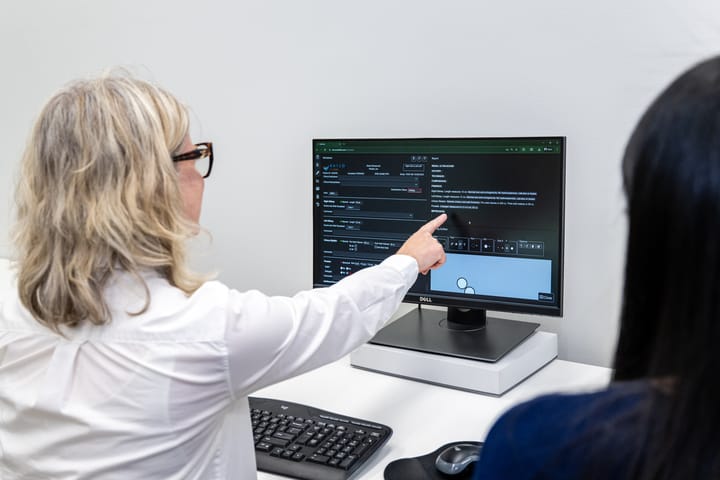
The CAR’s implementation guidance is instructive: successful adoption requires leadership support, stakeholder engagement, user-friendly templates, seamless IT and workflow integration, and ongoing support. The design philosophy behind KailoFlow is a direct response to this challenge. The platform is built around the premise that structured reporting should feel like the path of least resistance, not an additional burden layered onto an existing workflow.
Synoptic report generation: KailoFlow generates a preliminary structured report using technologist input, DICOM SR from the modality, and available AI analysis, so the radiologist reviews and finalises rather than creating from blank.
Automated measurement transfer: Measurements taken at the modality are automatically transferred into the relevant worksheet fields, eliminating manual data re-entry and a significant source of transcription error.
AI and algorithm integration: AI-generated outputs are surfaced directly within the reporting interface, providing radiologists with augmented insights without requiring context-switching to external tools.
KailoAir integration: Paired with KailoAir’s ambient AI dictation, voice narration is converted into structured, accurate reports in real time, combining the speed of dictation with the consistency of templates.
Device-agnostic web access: KailoFlow operates from any device without software installation, critical for multi-site departments and on-call radiologists.
Tailored template customisation: Departments can design worksheets that reflect their specific clinical workflows, subspecialty requirements, and RADS framework integrations, without requiring developer involvement.
Kailo Medical’s predecessor platform, SonoReview, has generated in excess of six million reports annually across its global install base: templates and workflows that radiologists have continued to use at scale because they made reporting better, not harder.
Structured Reporting and the AI-Ready Department
There is a broader strategic dimension to this conversation that radiology leaders should be considering now. The next five years will bring AI-assisted detection, LLM-generated draft reports, predictive clinical decision support, and population-level outcomes analytics, all of which depend, at their foundation, on structured data. The departments that transition to structured reporting today are not just improving their current workflows. They are building the informatics infrastructure that will determine how much value they can extract from the AI tools coming next.
Dr. Reuben Schmidt, Director of Clinical AI at Kailo Medical, has described his design philosophy clearly: “By reducing cognitive load and workflow friction, we enable radiologists to generate faster, more consistent, and higher-quality reports.” That is not a product pitch. It is a design principle, and it reflects a genuine understanding of what structured reporting is for.
“Going forward, the CAR will continue to provide suggested reporting templates to correspond with its library of clinical practice guidelines… Structured reporting in radiology has transformed reporting from unstructured narratives to structured templates, enabling better documentation, data analysis, decision support, and ultimately, enhanced patient care.”
The Argument is Over. The Implementation Conversation is Just Beginning.
The case for structured reporting in radiology is, at this point, closed. Every major imaging society, including the CAR, the ACR, the ESR, and RANZCR, has issued guidance supporting its adoption. The peer-reviewed literature demonstrating its benefits is extensive and consistent. The clinical, operational, and strategic arguments all point in the same direction.
What remains is the harder, more practical work: building the departmental culture, selecting the right platform, designing templates that reflect real subspecialty needs, and training reporters who span generations of habits. That work is where most organisations have struggled, and where the quality of the tooling matters enormously.
The goal is not structure for its own sake. It is reports that referring physicians can act on quickly, findings that can be compared across time and across populations, data that can be queried and mined and used to improve care. Getting there requires both conviction and the right infrastructure. The conviction, we hope, is no longer in doubt. The infrastructure is available.
References: O’Sullivan J, et al. CAR Position Statement on Structured Reporting, 2023. Ganeshan D, et al. Structured Reporting in Radiology, Academic Radiology 2018. Marcovici PA, Taylor GA. AJR 2014. Wetterauer C, et al. PLoS ONE 2019. Weiss DL, Langlotz CP. Radiology 2008. Schmidt R, et al. Radiology: AI 2024.