
-

15 Years in the Room: How Kailo Medical Builds What It Sees

  • Radiology
  • Reporting

Fifteen years ago, two founders watched a sonographer fight with a paper form and a jammed scanner. That moment, and the instinct behind it, still defines how Kailo Medical builds today.

There is a moment Bernard Duscher still remembers clearly.

He and his co-founder Robert Newman were on site with a client, there for something else entirely, when they noticed a sonographer working through a scan. She was filling out a paper form by hand, collecting measurements, writing up her findings, then feeding the page into a scanner. The paper jammed. She pulled it out, straightened it, and tried again.

That observation, made in 2011, led to the creation of Kailo Medical. And fifteen years on, it still defines how the company works.

We saw it firsthand and realized there must be a better way. It just looked completely inefficient. And we thought: we have the skills and the ability to connect the dots.
– Bernard Duscher, Co-Founder

The Philosophy That Built a Company

Kailo turns fifteen this June. In that time, the company has grown from two people to a team of more than forty, expanded from Australia to New Zealand, Canada, the United States, and South Africa, and processed over 50 million imaging cases across its products.

What hasn’t changed is the founding instinct: get in the room, watch what people actually do, and build from there.

That philosophy drove some unlikely early decisions. Most software companies start small, with a manageable client and a controlled rollout. Kailo’s first customer was I-MED Radiology, the largest private radiology group in the Asia Pacific, doing millions of exams a year. The complexity was enormous. But working through it forced the team to build integration capabilities that have since become one of their deepest competitive advantages.

The next win was Pacific Radiology in New Zealand. Then Canada. Then the United States. In each market, the same pattern held: the largest groups, the hardest environments, and a product that proved itself by going in without excuses.

There is no substitute for seeing it, feeling it, experiencing it. After fifteen years, I was still on site with a customer this week, just watching how they use the product. You can’t replicate that by sitting behind a screen.
– Bernard Duscher, Co-Founder

Evolution, Not Reinvention

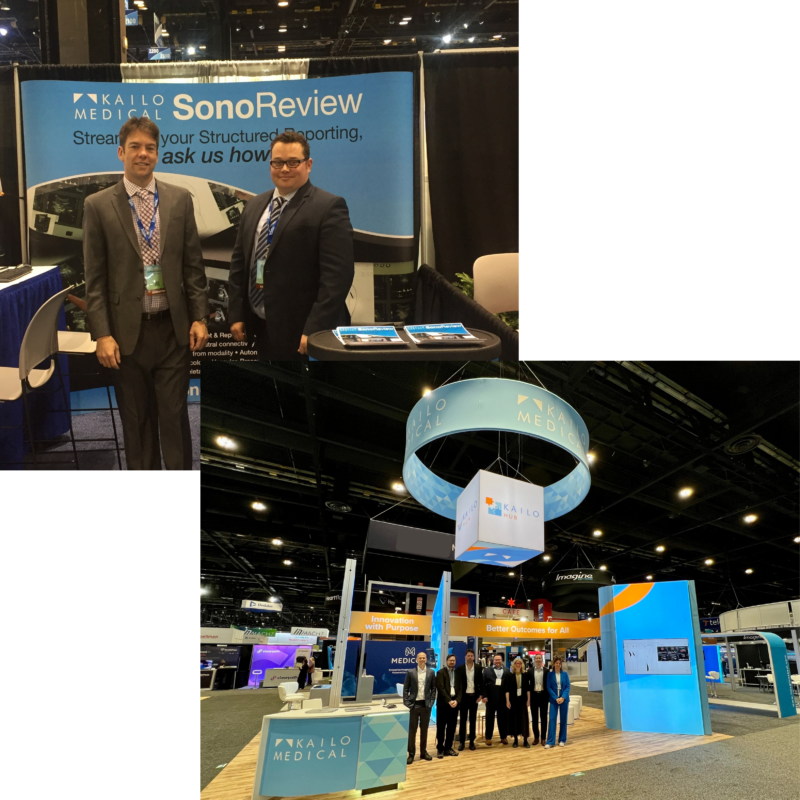
The original product, then called SonoReview, later evolved into the cloud-native KailoFlow. It was built for sonographers and imaging technologists, replacing paper-based workflows with structured digital reporting connected to whatever PACS, RIS, or ultrasound equipment was in the room.

The company’s founding motto was “everything in between.” Never a RIS. Never a PACS. But everything that bridges them.

That motto still holds. KailoFlow has evolved significantly over fifteen years, with broader modality support, deeper integrations, and a shift to cloud-native infrastructure. But the principle is the same: reduce friction between what the clinician observes and what ends up in the report.

The most recent chapter of that evolution is KailoAir, Kailo’s radiology reporting platform. And it started, as most things at Kailo do, with being in the room.

A client mentioned, almost in passing, that they should see what a radiologist on their team had built. Bernard and Rob went on-site. What they saw stopped them cold: Dr. Reuben Schmidt working through cases, speaking naturally, with the report forming around him in real time.

We were absolutely gobsmacked. It was a completely different paradigm. No clicking, no formatting commands, no adapting to the machine. He would just say what he saw, and it became a report.
– Bernard Duscher, Co-Founder

A dedicated team worked to bring Reuben’s approach into the Kailo ecosystem. The result is a unified environment, made up of KailoHub, KailoFlow, and KailoAir, in which the workflow from the first scan to the final report runs through a single connected platform.

In an industry where AI tools have proliferated as standalone widgets, that coherence is rare.

The Next Room

Fifteen years of building close to the customer has shaped more than the product. It has shaped how Kailo hires, how it expands, and how it thinks about scale.

The team that built this, including Jessica Wilson, Lauren Therriault, Jason Mercieca, and others who have been with the company for close to a decade each, is now growing into leadership roles. A new generation of Kailo people is carrying the same approach into new markets: the United States, where a Boston presence is now established, and the United Kingdom, where the company is actively building its footprint in 2026.

It feels like life has gone full circle. What he’s doing now is what I was doing fifteen years ago: going somewhere new, learning the environment, building trust by being present.
– Bernard Duscher, Co-Founder

The human body, as Bernard likes to note, is the same everywhere. Two kidneys. A liver. A pancreas. A spleen. The problems that radiologists and sonographers face in Melbourne aren’t fundamentally different from those in Calgary or Cape Town.

And the philosophy that has driven Kailo from day one, get in the room, see the problem, build the solution, travels just as well.

Fifteen years. Forty people. Millions of studies.

The paper doesn’t jam anymore. But Kailo is still in the room.